Charging Times and Setup Guide
Roughly 11 hours is required to fully replenish the battery using a Level 2 home charger. This specific timeframe applies to models equipped with the standard 73 kWh battery pack. Explore our available electric SUV selection at Greg Hubler Ford to see these advanced charging technologies in person.
Transitioning to an electric vehicle means changing how you “fuel” your daily commute. Instead of stopping at a gas station, you replenish the battery overnight. There are two primary ways to charge your vehicle at home in Delaware County.
Level 1 charging uses the standard Ford Mobile Power Cord plugged directly into a normal 120-volt household wall outlet. This method adds approximately 3 miles of range per charging hour. Because it is a slower connection, Level 1 is best suited for drivers who only travel a few miles a day around Muncie or the Ball State University campus.
Level 2 charging is the recommended home solution. It utilizes a 240-volt connection, which is the same type of heavy-duty outlet used by large appliances like clothes dryers. A properly installed Level 2 Ford Connected Charge Station delivers a significantly faster electrical current. This allows you to completely recharge the battery overnight while you sleep. For an in-depth explanation of these electrical standards, you can visit the Department of Energy Alternative Fuels Data Center.
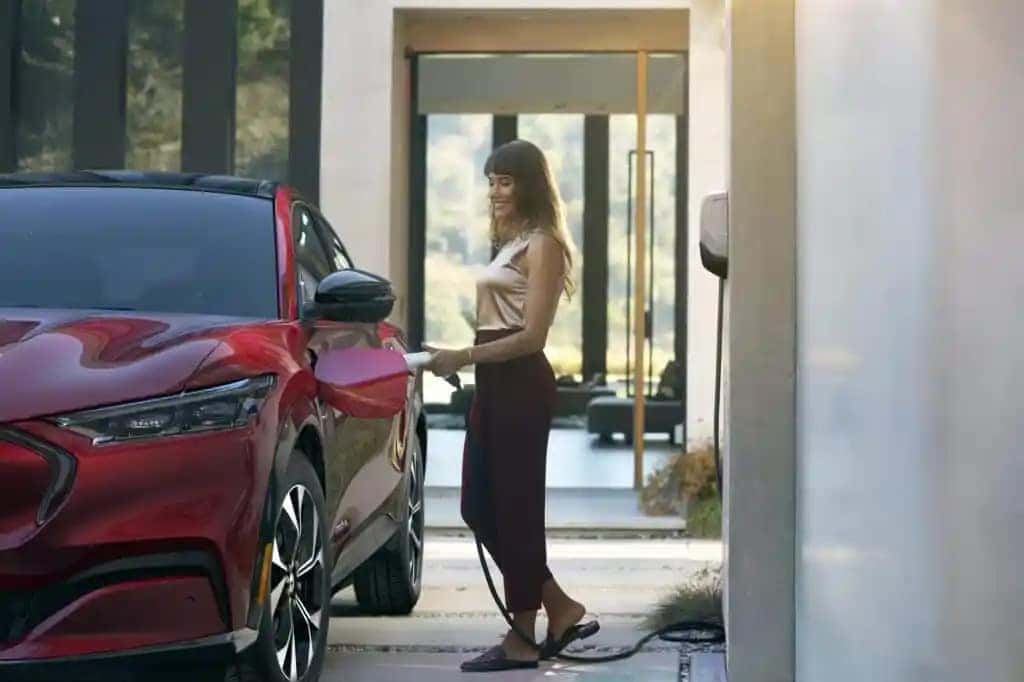
Understanding your equipment dictates your charge time. The following metrics break down expected charging durations based on connection types.
| Charging Method | Power Source | Estimated Time to Charge | Real-World Application |
|---|---|---|---|
| Level 1 Mobile Cord | 120V Standard Wall Outlet | Up to 95 hours (0 to 100 percent) | Minimal daily driving. |
| Level 2 Connected Station | 240V Dedicated Circuit | Roughly 11 hours (0 to 100 percent) | Overnight home charging. |
| DC Fast Charging | Public High-Voltage Station | 33 minutes (10 to 80 percent) | Highway road trips. |

When you travel outside the local Muncie area, DC Fast Charging stations become your primary power source. These public stations utilize direct current (DC) to bypass the vehicle’s onboard converter, delivering massive amounts of electricity directly to the battery. This hardware allows the vehicle to jump from a 10 percent charge to an 80 percent charge in just over 30 minutes when properly equipped.
Drivers have access to the BlueOval Charge Network, which aggregates thousands of public charging locations across North America into one seamless payment ecosystem. You can learn more about finding stations on the official Ford public charging network page.
Indiana winters directly impact battery performance. When temperatures drop below freezing around Delaware County, the chemical reactions inside the lithium-ion battery slow down. This means charging sessions take slightly longer in January than they do in July. Furthermore, heating the cabin requires drawing energy directly from the battery pack, which temporarily reduces your maximum driving range.
To combat this, the vehicle features intelligent preconditioning. By using the FordPass app while the vehicle is still plugged in at your house, you can warm up the battery and the cabin using electricity from the grid rather than depleting your stored battery power. To see how these thermal management systems integrate with the broader vehicle architecture, check out our complete 2026 Ford Mustang Mach-E overview at Greg Hubler Ford.
Ready to leave the gas pump behind? The 2026 Mustang Mach-E is engineered for seamless home charging and rapid highway refueling. Browse our inventory or schedule your test drive today.